
Eric Michel Ministries International
Les ministères Eric Michel International
A New Life Catholic Franciscan Ministry
And Sub-Ministries
We are using the Episcopal Ritual from the Book of Common Prayer.
Ministère franciscain catholique « Une vie nouvelle »
Et ses sous-ministères
Nous utilisons les rituels épiscopaux issus du Livre de la prière commune.
We have no link with the Roman Catholic Church or the Anglican/Episcopal Church.
Nous n’avons aucun lien avec l’Église catholique romaine ni avec l’Église anglicane/épiscopale.
Note that our dirigeant, Eric M. Gagnon, personally works with the Roman Catholic Church due to their common interest. He his know as Brother Eric.
Il convient de noter que notre dirigeant, Eric M. Gagnon, collabore personnellement avec l’Église catholique romaine en raison de leurs intérêts communs. On le connaît sous le nom de Frère Eric.
- Brother Eric is a Voluntary Chaplain member of the National Association of Catholic Chaplains
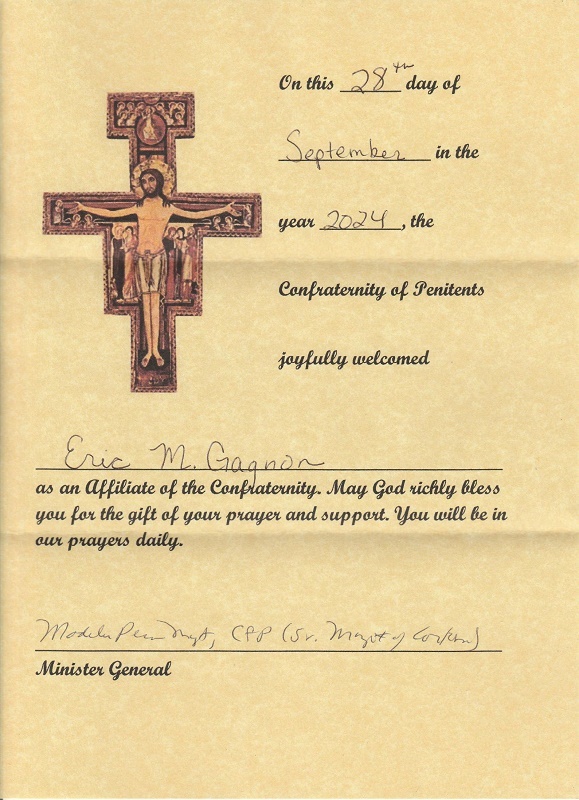
- He is also a member of the Confraternity of Penitents
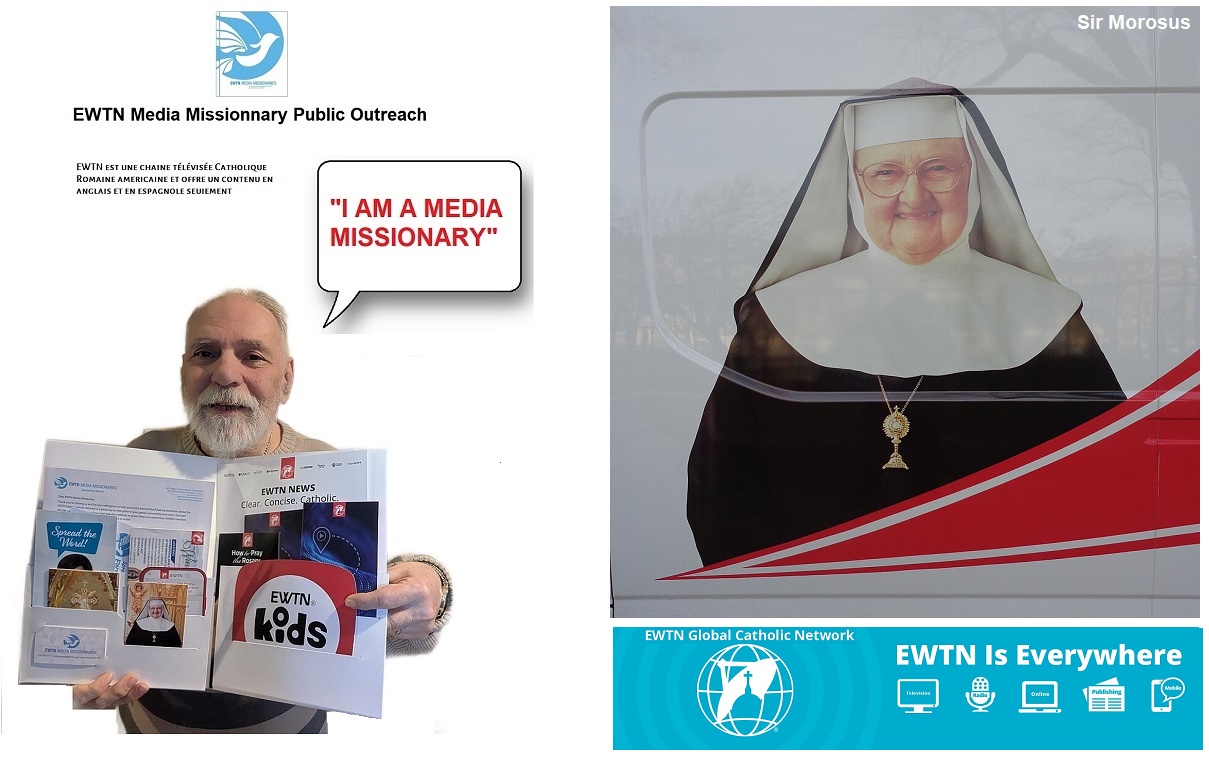
- And a member of the EWTN Missionary


Notre légalité, comme pour tout organisme utilisant le nom “Catholique“.
Un organisme sans but lucratif (OSBL) se disant “catholique indépendant” est légal au Canada s’il est constitué en entité juridique (provinciale ou fédérale), mais il n’est généralement pas reconnu par l’Église catholique romaine. Ces entités fonctionnent comme des associations privées. Elles peuvent obtenir le statut fiscal d’OSBL ou celui d’organisme de bienfaisance enregistré.
Voici les points clés sur la légalité et le statut :
Statut juridique : L’organisme doit être constitué en personne morale pour être reconnu légalement (ex. : Loi sur les corporations religieuses au Québec ou Loi canadienne sur les organisations à but non lucratif).
Indépendance religieuse : “Catholique indépendant” signifie qu’il n’est ni sous l’autorité d’un évêque catholique romain ni sous celle du Vatican. Sa légalité civile est distincte de sa légitimité religieuse.
Fiscalité (ARC) : Un OSBL est généralement exonéré d’impôt, mais ne peut pas délivrer de reçus officiels pour des dons. Pour émettre des reçus, il doit obtenir le statut d’organisme de bienfaisance enregistré auprès de l’Agence du revenu du Canada (ARC), qui exige que les fins soient reconnues comme religieuses.
Dissolution : Lors de sa dissolution, les biens d’un OSBL doivent être dévolus à une autre entité à but non lucratif, conformément à la loi.
Il est recommandé de vérifier le statut de l’organisme au Registre des entreprises du Québec ou au Registre des organismes de bienfaisance de l’ARC afin d’en valider la conformité.
Our legality as an organization using the Catholic name
A non-profit organization calling itself “Catholic independent” can operate legally in Canada, provided it adheres to federal and provincial regulations for not-for-profit organizations (NPOs) or, if applicable, registered charities. In Canada, religious freedom is protected under the Charter of Rights and Freedoms, allowing diverse religious groups to organize and operate freely, regardless of their affiliation with the Roman Catholic Church.
Here is the breakdown of the legality of such organizations:
Legal Structure and NPO Status
Definition: An “independent” Catholic organization is generally considered a Non-Profit Organization (NPO) or a charity, separate from the Roman Catholic Church’s hierarchical structure (dioceses, bishops).
Registration: These organizations can incorporate under the Canada Not-for-Profit Corporations Act (federal) or provincial not-for-profit corporations acts (e.g., the Ontario Not-for-Profit Corporations Act) to gain legal recognition and limited liability.
Legality of the Name: Using the term “Catholic” in a name is generally permissible, provided it does not deliberately mislead donors or commit fraud. It signifies adherence to a set of doctrines rather than necessarily belonging to the Roman Catholic Church.
Taxation and Charitable Status
NPO vs. Charity: An independent Catholic organization can operate as an NPO without being registered as a charity. However, to issue tax-deductible receipts, it must register as a charity with the Canada Revenue Agency (CRA).
Charitable Requirements: To be a registered charity, the organization must prove it advances religion (a recognized charitable purpose) or provides a public benefit.
Examples: Some independent Catholic groups, such as the Eucharistic Catholic Church, are registered with the CRA as charities.
Regulatory Oversight
CRA Oversight: The Canada Revenue Agency (CRA) regulates registered charities, ensuring compliance with the Income Tax Act.
Limitations: While advancing religion is a valid charitable purpose, it does not exempt an organization from complying with Canadian law, including anti-discrimination laws.
Distinctions
Not Roman Catholic: A “Catholic independent” organization is not recognized by the Canadian Conference of Catholic Bishops (CCCB) or the Vatican as part of the Roman Catholic Church.
Autonomy: They are legally independent entities that manage their own affairs, property, and, often, their own form of ministry.
In summary, it is legal for an independent organization to call itself “Catholic” in Canada, as long as it adheres to the regulatory requirements for non-profits and, if necessary, charity registration, while operating within Canadian law.