
Location: Manse’s Chapel
✠ The Altar Crucifix — What we know, and why it matters
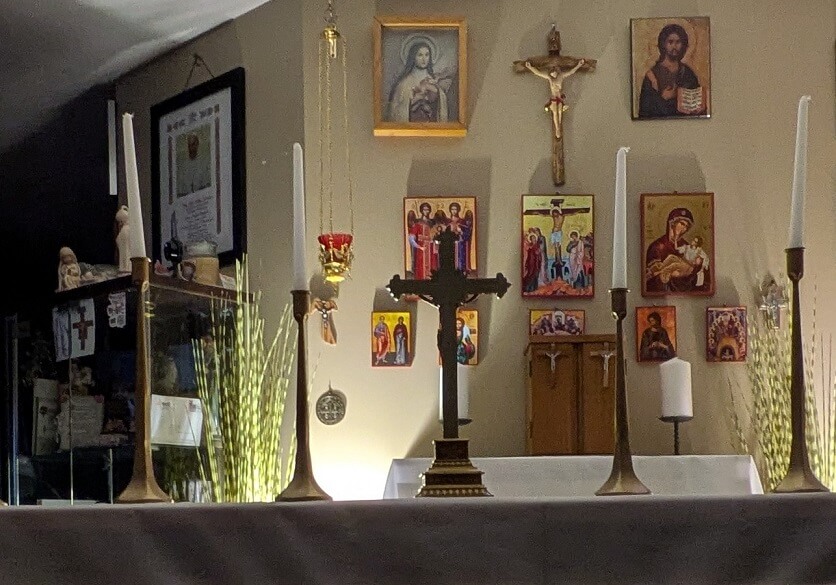
The altar crucifix is not a decoration. It is a theological anchor placed at the very heart of the altar—where sacrifice, presence, and remembrance meet.
📜 What the Church actually requires
According to the General Instruction of the Roman Missal (GIRM):
- There must be a cross with the figure of Christ crucified (a crucifix, not just a bare cross).
- It should be:
- on the altar or
- near the altar
- It must be clearly visible to the priest and the faithful.
👉 The key is visibility and meaning—not size or ornament.
✝️ Why a crucifix (and not just a cross)?
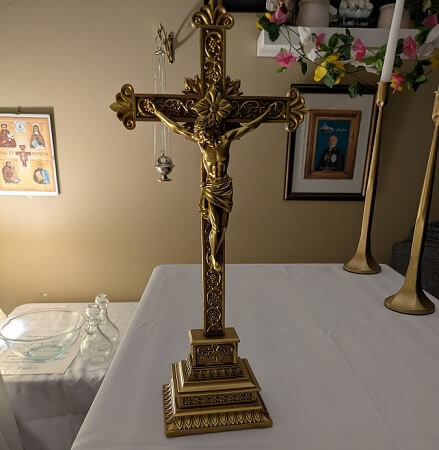
A plain cross shows victory.
A crucifix shows the sacrifice.
At every Mass, the Church makes present the mystery of the Crucifixion of Jesus, not repeated, but sacramentally re-presented.
So the crucifix reminds us:
- The altar is not a table alone
- It is also Calvary made present
🕯️ Placement and symbolism
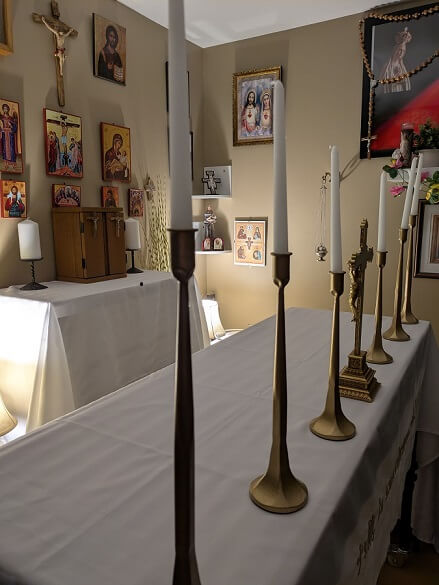
Traditionally, especially in more classical settings:
- The crucifix is placed at the center of the altar
- Flanked by candles (often 2, 4, or 6)
This creates a visual theology:
- Center → Christ crucified
- Light → divine presence, resurrection hope
- Altar → sacrifice and offering
⛪ Different liturgical expressions
Traditional (pre–Vatican II form)
- The crucifix often faces the priest
- Emphasis: priest and people oriented together toward Christ
Post–Second Vatican Council (Ordinary Form)
- A crucifix may face the people or be centrally visible
- Emphasis: communal participation, without losing the sacrificial focus
👉 In both cases, the meaning is identical:
Christ crucified is the center of the liturgy
🪵 Styles you may encounter

- Simple wood → humility, poverty (Franciscan spirit)
- Ornate gold → kingship and glory
- San Damiano style → iconographic, rich in symbolism (linked to Francis of Assisi)
None is “more valid”—only more expressive of a spiritual emphasis
🔥 Spiritual meaning (the heart of it)
The altar crucifix silently proclaims:
- “This is My Body, given for you”
- “This is My Blood, poured out for you”
It teaches without words:
- Sacrifice is love made visible
- The Eucharist is inseparable from the Cross
- The priest acts in the person of Christ crucified
In Eucharista et per Mariam
The altar crucifix becomes:
- The axis between Eucharist and sacrifice
- The bridge between altar and mission
- The silent catechist for every soul who enters
✠ The Altar Crucifix For Chaplain
For the ones who have followed me for a long time, the crucifix that I published was this one:

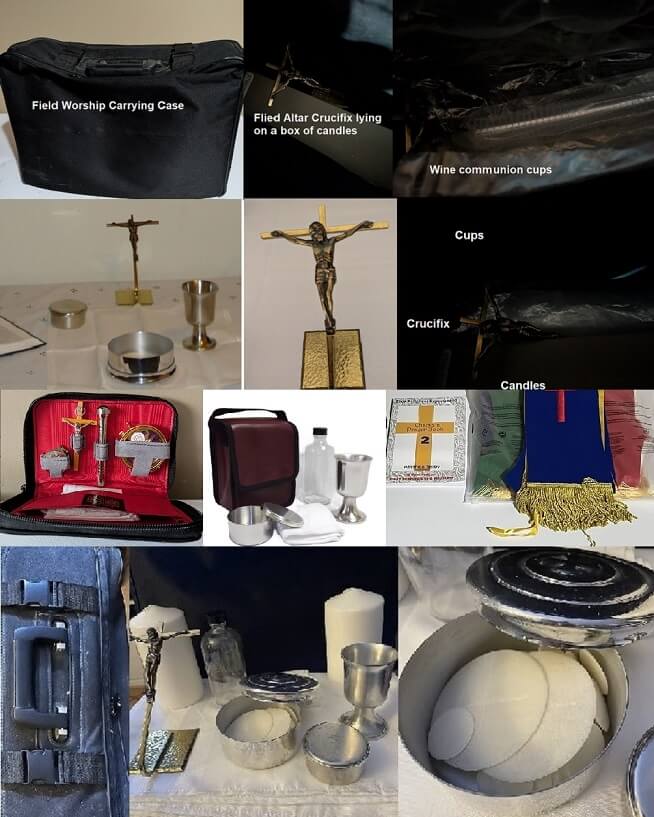
That is my portable Altar Crucifix for the field
Size comparison

When not in use, most of the time, you will find it in my field worship case:
✝️ The Crucifix at the Altar
Before every word is spoken, before every prayer is lifted, the Crucifix already speaks.
It does not argue.
It does not explain.
It simply reveals:
Love poured out.
Here, at the altar, we do not remember a distant moment.
We stand at the foot of the Crucifixion of Jesus,
where mercy was opened,
where the Heart of Christ was given without reserve.
The wood of the Cross and the table of the altar are one mystery:
sacrifice and offering,
death and life,
silence and the eternal Word.
And beside the Cross, unseen yet ever present, stands the Mother
Mary, Mother of Jesus
teaching us how to remain, how to receive, how to believe.
In every Eucharist,
What is lifted is not only bread and wine,
But the whole offering of Christ Himself.
And we are invited, quietly, freely,
to place our own lives there as well:
our burdens,
our wounds,
our hidden prayers.
Nothing is too small to be united
to so great a Love.
So we look upon the Crucifix…
And we learn again:
not how to speak,
But how to give.