Advent 2026 begins on Sunday, November 29, 2026, and runs through Wednesday, December 24, 2026 (Christmas Eve)
Key Dates for Advent 2026
- First Sunday of Advent (Hope): November 29, 2026
- Second Sunday of Advent (Peace): December 6, 2026
- Third Sunday of Advent / Gaudete Sunday (Joy): December 13, 2026
- Fourth Sunday of Advent (Love): December 20, 2026
- Christmas Eve: December 24, 2026
- Christmas Day: December 25, 2026
New Liturgical Year: The First Sunday of Advent marks the start of Year C in the liturgical cycle for Catholics and many Christian denominations.
Advent Wreath Tradition: An evergreen wreath with four candles (three purple/blue and one rose/pink) is used to count down the weeks. A new candle is lit each Sunday to symbolize Christ’s growing light.
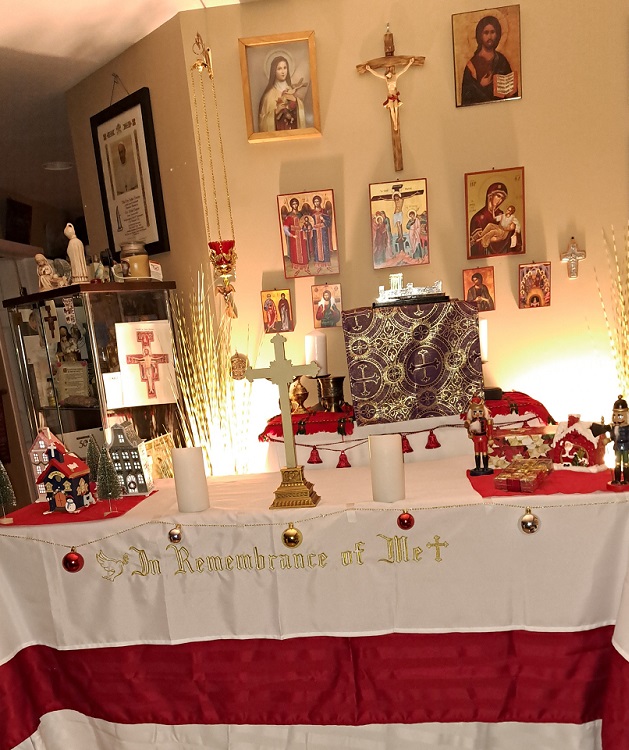
NOTE: In pictures, the Tabernacle is covered in mauve (purple); that will be good from November 29th, but for now the Liturgical Colours on Nov.:
- 16 Green
- 17 White Our Saint, Elizabeth of Hungary OFS
- 18 – 19 – 20 Green
- 21 White Presentation of Holly Mary
- 22 White Christ King
- 23 Green
- 24 Purple St. Andrew Dunglac
- 25 – 26 – 27 – 28 Green
Changing Year B Year 1
Advent

Wreath: A circular evergreen structure holding four candles (traditionally three purple and one rose/pink).
- Week 1 (Nov 29): Hope (Purple candle)
- Week 2 (Dec 6): Peace (Purple candle)
- Week 3 (Dec 13): Joy (Rose/pink candle for Gaudete Sunday)
- Week 4 (Dec 20): Love (Purple candle)

Saint Nicholas of Myra[a] (traditionally 15 March 270 – 6 December 343), also known as Nicholas of Bari, was an early Christian bishop of Greek descent from the maritime city of Patara in Anatolia (modern-day Antalya Province, Turkey) during the Roman Empire. Because of the many miracles attributed to his intercession, he is also known as Nicholas the Wonderworker. Saint Nicholas is the patron saint of sailors, merchants, archers, repentant thieves, children, brewers, pawnbrokers, toymakers, unmarried people, and students in various cities and countries around Europe. His reputation evolved among the pious, as was common for early Christian saints, and his legendary habit of secret gift-giving gave rise to the folklore of Santa Claus (“Saint Nick”) through Sinterklaas.
Little is known about the historical Saint Nicholas. The earliest accounts of his life were written centuries after his death and probably contain legendary elaborations. He is said to have been born in the Anatolian seaport of Patara, Lycia, in Asia Minor to wealthy Christian parents.
Santa Claus is a legendary figure in Western Christian culture, said to bring gifts late in the evening and overnight on Christmas Eve. Christmas elves are said to make the gifts in Santa’s workshop, while flying reindeer pull his sleigh through the air.
The popular conception of Santa Claus originates from folklore traditions surrounding the 4th-century Christian Greek bishop Saint Nicholas, the patron saint of children. Saint Nicholas became renowned for his reported generosity and secret gift-giving. The image of Santa Claus resembles the English figure of Father Christmas, and both are now popularly regarded as the same person.
Father Christmas is the traditional English name for the personification of Christmas. Although now known as a Christmas gift-bringer and typically considered synonymous with Santa Claus, he originally came from a much older, unrelated English folkloric tradition. The recognizably modern English Father Christmas developed in the late Victorian period, but People had personified Christmas for centuries before then. English personifications of Christmas first appeared in the 15th century, with Father Christmas himself appearing in the mid-17th century after the English Civil War.