From Wolfe Cub to Chaplain

Two factors from my youth that contributed to my decision to become a Chaplain. First, our Parish Chaplain, Father Legris, and the Scout movement began as Wolf Cubs and later evolved into Boy Scouts, where I learned to be of service and always be ready to help someone. In my mind, I had been a chaplain since my teenage years. The desire to help led me to become a Street Outreach Worker in French, “Travailleur de rue,” for an addiction center in 1993, and a Bivocational Minister since 1988. I was there, but not entirely.

So, it was normal to have the goal of becoming a real Chaplain working for the church. I was ordained a Chaplain in 2011. I have been working for the International Federation of Christian Chaplains since 14 November 2012. (https://www.facebook.com/ChaplainFederation) .

During my training with Révérend Michel Beaumier of the Evangelical Christian Church of Lorraine, on our way to lunch, walking side by side, he asked me why I didn’t have my own chaplaincy.

From this, I worked toward this new goal, my own chaplaincy. It took me two years, and it happened in 2014, when I registered with the federal government on 14 July. The Reverend Mary joined me in May 2012. She is a Baptist Minister, and we raised the chaplaincy until 2020 when I decided to become Catholic. Franciscan one.

I joined the National Association of Catholic Chaplains on 10 March 2022 (https://www.facebook.com/choosechaplaincy)

As the NACC and the IFCC are American, I sought a Canadian Chaplaincy, which I found and became an Affiliate on 27 September 2024 at the Canadian Practical Chaplain Association (https://www.facebook.com/profile.php?id=100064838522731).

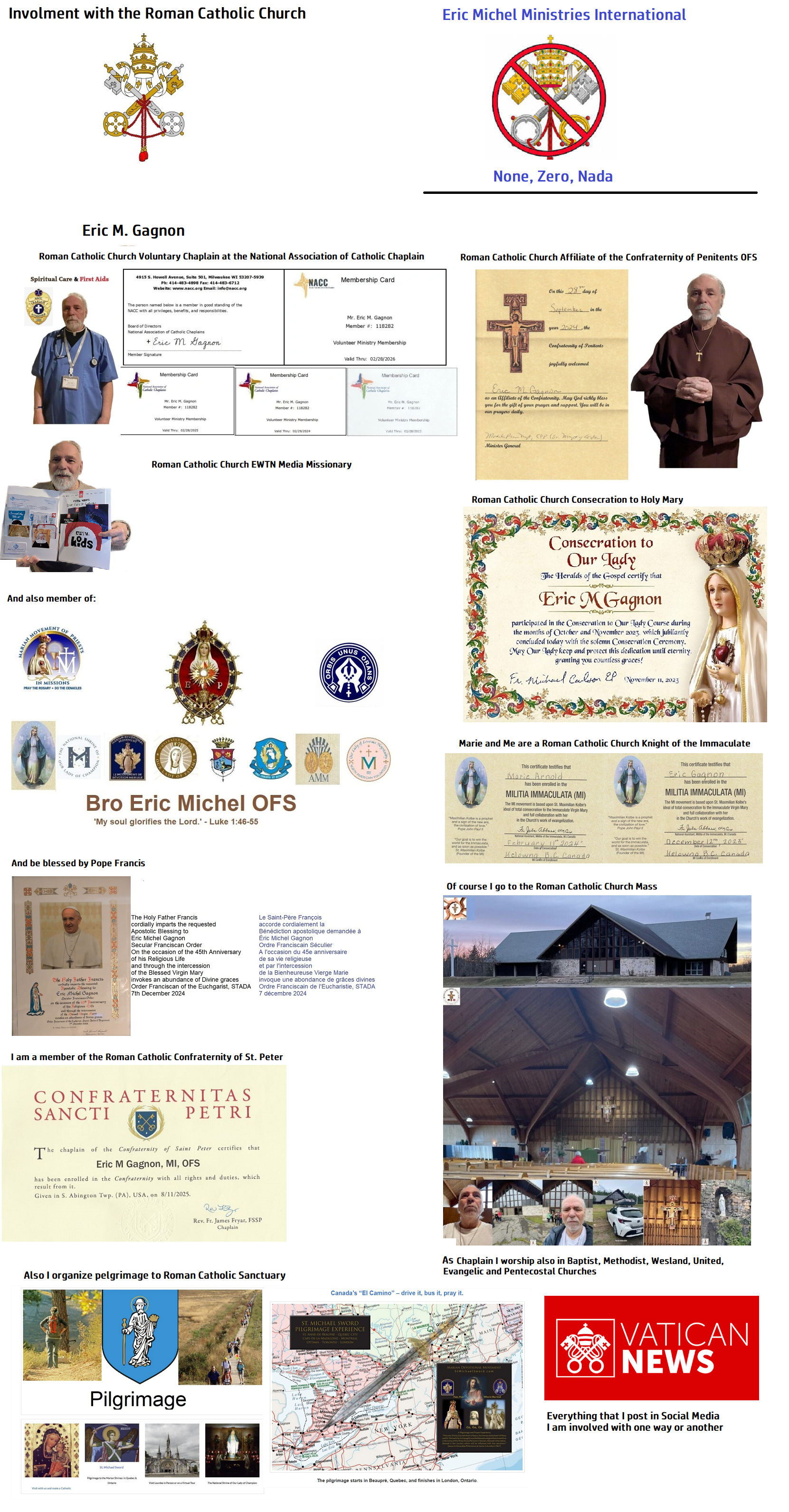
However, the Ministries remained Protestant, and after a resolution by the House of Bishops and the Board of Elders, the organization Eric Michel Ministries International became Catholic and requested an Amendment to our constitution, which Corporation Canada granted on 14 January 2025.

REF.: https://franciscanseucharist.com/?page_id=64

My decision to become a Chaplain.

Previously posted on September 1 at https://franciscanseucharist.ca/

Two factors from my youth that contributed to my decision to become a Chaplain. First, our Parish Chaplain, Father Legris, and the Scout movement began as Wolf Cubs and later evolved into Boy Scouts, where I learned to be of service and always be ready to help someone. In my mind, I had been a chaplain since my teenage years. The desire to help led me to become a Street Outreach Worker in French, “Travailleur de rue,” for an addiction center in 1993, and a Bivocational Minister since 1988. I was there, but not entirely.

So, it was normal to have the goal of becoming a real Chaplain working for the church. I was ordained a Chaplain in 2011. I have been working for the International Federation of Christian Chaplains since 14 November 2012. (https://www.facebook.com/ChaplainFederation) .

During my training with Révérend Michel Beaumier of the Evangelical Christian Church of Lorraine, on our way to lunch, walking side by side, he asked me why I didn’t have my own chaplaincy.

From this, I worked toward this new goal, my own chaplaincy. It took me two years, and it happened in 2014, when I registered with the federal government on 14 July. The Reverend Mary joined me in May 2012. She is a Baptist Minister, and we raised the chaplaincy until 2020 when I decided to become Catholic. Franciscan one.

I joined the National Association of Catholic Chaplains on 10 March 2022 (https://www.facebook.com/choosechaplaincy)

As the NACC and the IFCC are American, I sought a Canadian Chaplaincy, which I found and became an Affiliate on 27 September 2024 at the Canadian Practical Chaplain Association (https://www.facebook.com/profile.php?id=100064838522731).

However, the Ministries remained Protestant, and after a resolution by the House of Bishops and the Board of Elders, the organization Eric Michel Ministries International became Catholic and requested an Amendment to our constitution, which Corporation Canada granted on 14 January 2025.

REF.: https://franciscanseucharist.com/?page_id=64

Our Lady of Grace

Previously posted on September 1 at https://franciscanseucharist.ca/

The first settlers, accompanied by Philemon Wright, settled in Hull in 1800, probably near Lake Leamy. The following year, Philemon Wright built a sawmill and a flour mill near Chaudière Falls. The town of Hull grew rapidly and became one of the largest cities in Quebec, with a population of 800 inhabitants by 1824. The name Hull recalls the city of the same name in the United Kingdom, from which Philemon Wright originally came.

The parish of Notre-Dame-de-Grâce was canonically erected on 14 November 1870. It was then entrusted to the Congregation of Oblates. A first chapel was built in 1846. The construction of a stone church took place from 1868 to 1874. It was blessed in 1870 by Bishop Eugène Bruno Guigues of Ottawa. On 5 June 1888, a major fire destroyed several buildings, including the church. The latter was quickly rebuilt, and Bishop Thomas Duhamel came to bless it in 1892. This second church, in turn, burned down on 12 December 1971. It was not rebuilt. It was located at the corner of Notre-Dame-de-l’Île and Victoria streets in Gatineau.

My parish belongs to the Roman Catholic Diocese of Ottawa.

Montpellier, Église catholique du Québec

Previously posted on August 31 at https://franciscanseucharist.ca/

Queen of the World

Previously posted on August 24 at https://franciscanseucharist.ca/

The Feast of Mary, Queen of the World, is celebrated on August 22nd. It is the octave day (8th day) after the Solemnity of the Assumption of Mary, which is celebrated on August 15th. The feast day was established by Pope Pius XII in 1954. The Second Vatican Council in 1964 referred to Mary as Queen of the Universe.

The Queenship of Mary is closely linked to the Kingship of her Son, Jesus. Catholic tradition holds that just as Christ is King, Mary is Queen due to her role in the story of divine redemption as the mother of the Saviour.

Several traditions and prayers honour Mary’s Queenship, including the “Hail, Holy Queen” prayer, hymns like “Hail, Queen of Heaven,” and invocations in the Litany of Loreto. The feast day is a logical extension of the Assumption, celebrating Mary’s role in salvation history and her place in heaven.

Queen of Heaven (Latin: Regina Caeli) is a title given by the Catholic Church and Eastern Orthodoxy to Mary, mother of Jesus, and, to a lesser extent, in Anglicanism and Lutheranism. The title has long been a tradition, included in prayers and devotional literature and seen in Western art in the subject of the Coronation of the Virgin from the High Middle Ages, long before the Church gave it a formal definition.

The Catholic teaching on this subject is expressed in the papal encyclical Ad Caeli Reginam, issued by Pope Pius XII in 1954. Therein, the pope states that Mary is called Queen of Heaven because her son, Jesus Christ, was charged as being “King of Israel” and the heavenly king of the universe. This would render the mother of the king as the “queen mother” of Israel.

She is invoked in the Litany of Loreto as:

Queen of the Angels
Queen of Patriarchs
Queen of Prophets
Queen of Apostles
Queen of Martyrs
Queen of Confessors
Queen of Virgins
Queen of all Saints
Queen of Families
Queen conceived without original sin
Queen ascended into Heaven
Queen of the Most Holy Rosary
Queen of Peace

Queenship of Mary is a Marian feast day in the liturgical calendar of the Catholic Church, created by Pope Pius XII. On 11 October 1954, the pontiff pronounced the new feast in his encyclical Ad caeli reginam. The feast was celebrated on May 31, the last day of the Marian month. The initial ceremony for this feast involved the crowning of the Salus Populi Romani icon of Mary in Rome by Pius XII as part of a procession in Rome.

In 1969, Pope Paul VI moved the feast day to August 22, the former Octave day of the Assumption, to emphasize the close bond between Mary’s queenship and her glorification in body and soul next to her Son. The Second Vatican Council’s Constitution on the Church states that “Mary was taken up body and soul into heavenly glory, and exalted by the Lord as Queen of the universe, that she might be the more fully conformed to her Son” (Lumen gentium, 59).

The movement to officially recognize the Queenship of Mary was initially promoted by several Catholic Mariological congresses in Lyon, France; Freiburg, Germany; and Einsiedeln, Switzerland. Gabriel Roschini, founded in Rome, Italy, an international society to promote the Queenship of Mary, Pro Regalitate Mariae. Several popes had described Mary as Queen and Queen of Heaven, which Roschini documented. Pope Pius XII repeated the title in numerous encyclicals and apostolic letters, especially during World War II.

The small and simple young girl of Nazareth became Queen of the world! This is one of the marvels that reveal God’s Heart. Of course, Mary’s queenship is relative to Christ’s kingship. He is the Lord whom, after the humiliation of death on the Cross, the Father exalted above any other creature in Heaven and on earth and under the earth (cf. Phil 2:9-11). Through a design of grace, the Immaculate Mother was entirely associated with the mystery of the Son: in his Incarnation; in his earthly life, at first hidden at Nazareth and then manifested in the messianic ministry; in his Passion and death; and finally, in the glory of his Resurrection and Ascension into Heaven … Benedict XVI.

The Queenship of Mary is commemorated in the last of the Glorious Mysteries of the Holy Rosary, the Coronation of the Virgin as Queen of Heaven and Earth.

Parishes and private groups often process and crown an image of Mary with flowers. This is often referred to as a “May Crowning”. This rite may be done on solemnities and feasts of the Blessed Virgin Mary, or other festive days, and offers the Church a chance to reflect on Mary’s role in the history of salvation.

The Virgin has been called “Queen of France” since 1638, when, partly in thanksgiving for a victory over the Huguenots and also in hope of the birth of an heir after years of childless marriage, Louis XIII officially gave her that title. Siena, Tuscany, hails the Virgin as Queen of Siena, and annually observes the race and pageant called the “palio” in her honour.

Mary was declared “Queen of Poland” by King John II Casimir during the Lwów Oath in the 17th century. Since then, she is believed to have saved the country miraculously during the Deluge, the Partitions of Poland, the Polish-Soviet War, World War II and the Polish People’s Republic. The solemnity of Our Lady Queen of Poland is celebrated on 3 May.

www.wikipedia.org

Mary Queen of the World

The Feast of Mary, Queen of the World, is celebrated on August 22nd. It is the octave day (8th day) after the Solemnity of the Assumption of Mary, which is celebrated on August 15th. The feast day was established by Pope Pius XII in 1954. The Second Vatican Council in 1964 referred to Mary as Queen of the Universe.

The Queenship of Mary is closely linked to the Kingship of her Son, Jesus. Catholic tradition holds that just as Christ is King, Mary is Queen due to her role in the story of divine redemption as the mother of the Saviour.

Several traditions and prayers honour Mary’s Queenship, including the “Hail, Holy Queen” prayer, hymns like “Hail, Queen of Heaven,” and invocations in the Litany of Loreto. The feast day is a logical extension of the Assumption, celebrating Mary’s role in salvation history and her place in heaven.

Queen of Heaven (Latin: Regina Caeli) is a title given by the Catholic Church and Eastern Orthodoxy to Mary, mother of Jesus, and, to a lesser extent, in Anglicanism and Lutheranism. The title has long been a tradition, included in prayers and devotional literature and seen in Western art in the subject of the Coronation of the Virgin from the High Middle Ages, long before the Church gave it a formal definition.

The Catholic teaching on this subject is expressed in the papal encyclical Ad Caeli Reginam, issued by Pope Pius XII in 1954. Therein, the pope states that Mary is called Queen of Heaven because her son, Jesus Christ, was charged as being “King of Israel” and the heavenly king of the universe. This would render the mother of the king as the “queen mother” of Israel.

She is invoked in the Litany of Loreto as:

Queen of the Angels
Queen of Patriarchs
Queen of Prophets
Queen of Apostles
Queen of Martyrs
Queen of Confessors
Queen of Virgins
Queen of all Saints
Queen of Families
Queen conceived without original sin
Queen ascended into Heaven
Queen of the Most Holy Rosary
Queen of Peace

Queenship of Mary is a Marian feast day in the liturgical calendar of the Catholic Church, created by Pope Pius XII. On 11 October 1954, the pontiff pronounced the new feast in his encyclical Ad caeli reginam. The feast was celebrated on May 31, the last day of the Marian month. The initial ceremony for this feast involved the crowning of the Salus Populi Romani icon of Mary in Rome by Pius XII as part of a procession in Rome.

In 1969, Pope Paul VI moved the feast day to August 22, the former Octave day of the Assumption, to emphasize the close bond between Mary’s queenship and her glorification in body and soul next to her Son. The Second Vatican Council’s Constitution on the Church states that “Mary was taken up body and soul into heavenly glory, and exalted by the Lord as Queen of the universe, that she might be the more fully conformed to her Son” (Lumen gentium, 59).

The movement to officially recognize the Queenship of Mary was initially promoted by several Catholic Mariological congresses in Lyon, France; Freiburg, Germany; and Einsiedeln, Switzerland. Gabriel Roschini, founded in Rome, Italy, an international society to promote the Queenship of Mary, Pro Regalitate Mariae. Several popes had described Mary as Queen and Queen of Heaven, which Roschini documented. Pope Pius XII repeated the title in numerous encyclicals and apostolic letters, especially during World War II.

The small and simple young girl of Nazareth became Queen of the world! This is one of the marvels that reveal God’s Heart. Of course, Mary’s queenship is relative to Christ’s kingship. He is the Lord whom, after the humiliation of death on the Cross, the Father exalted above any other creature in Heaven and on earth and under the earth (cf. Phil 2:9-11). Through a design of grace, the Immaculate Mother was entirely associated with the mystery of the Son: in his Incarnation; in his earthly life, at first hidden at Nazareth and then manifested in the messianic ministry; in his Passion and death; and finally, in the glory of his Resurrection and Ascension into Heaven … Benedict XVI.

The Queenship of Mary is commemorated in the last of the Glorious Mysteries of the Holy Rosary, the Coronation of the Virgin as Queen of Heaven and Earth.

Parishes and private groups often process and crown an image of Mary with flowers. This is often referred to as a “May Crowning”. This rite may be done on solemnities and feasts of the Blessed Virgin Mary, or other festive days, and offers the Church a chance to reflect on Mary’s role in the history of salvation.

The Virgin has been called “Queen of France” since 1638, when, partly in thanksgiving for a victory over the Huguenots and also in hope of the birth of an heir after years of childless marriage, Louis XIII officially gave her that title. Siena, Tuscany, hails the Virgin as Queen of Siena, and annually observes the race and pageant called the “palio” in her honour.

Mary was declared “Queen of Poland” by King John II Casimir during the Lwów Oath in the 17th century. Since then, she is believed to have saved the country miraculously during the Deluge, the Partitions of Poland, the Polish-Soviet War, World War II and the Polish People’s Republic. The solemnity of Our Lady Queen of Poland is celebrated on 3 May.

Lapel Pin St Peter

An “FSSP church” refers to a parish or apostolate served by the Priestly Fraternity of Saint Peter (FSSP), a traditionalist Catholic clerical society of apostolic life for priests who celebrate the traditional Latin Mass. The FSSP is in communion with the Holy See and focuses on preserving and promoting the use of the extraordinary form of the Roman Rite within the Catholic Church.

QUEEN MARY

The Feast of Mary, Queen of the World, is celebrated on August 22nd. It is the octave day (8th day) after the Solemnity of the Assumption of Mary, which is celebrated on August 15th. The feast day was established by Pope Pius XII in 1954. The Second Vatican Council in 1964 referred to Mary as Queen of the Universe.

The Queenship of Mary is closely linked to the Kingship of her Son, Jesus. Catholic tradition holds that just as Christ is King, Mary is Queen due to her role in the story of divine redemption as the mother of the Saviour.


Several traditions and prayers honour Mary’s Queenship, including the “Hail, Holy Queen” prayer, hymns like “Hail, Queen of Heaven,” and invocations in the Litany of Loreto. The feast day is a logical extension of the Assumption, celebrating Mary’s role in salvation history and her place in heaven.

Queen of Heaven (Latin: Regina Caeli) is a title given by the Catholic Church and Eastern Orthodoxy to Mary, mother of Jesus, and, to a lesser extent, in Anglicanism and Lutheranism. The title has long been a tradition, included in prayers and devotional literature and seen in Western art in the subject of the Coronation of the Virgin from the High Middle Ages, long before the Church gave it a formal definition.

The Catholic teaching on this subject is expressed in the papal encyclical Ad Caeli Reginam, issued by Pope Pius XII in 1954. Therein, the pope states that Mary is called Queen of Heaven because her son, Jesus Christ, was called “King of Israel” and the heavenly king of the universe. This would render the king’s mother the “queen mother” of Israel.

She is invoked in the Litany of Loreto as:

Queen of the Angels
Queen of Patriarchs
Queen of Prophets
Queen of Apostles
Queen of Martyrs
Queen of Confessors
Queen of Virgins
Queen of all Saints
Queen of Families
Queen conceived without original sin
Queen ascended into Heaven
Queen of the Most Holy Rosary
Queen of Peace

Queenship of Mary is a Marian feast day in the liturgical calendar of the Catholic Church, created by Pope Pius XII. On 11 October 1954, the pontiff pronounced the new feast in his encyclical Ad caeli reginam. The feast was celebrated on May 31, the last day of the Marian month. The initial ceremony for this feast involved the crowning of the Salus Populi Romani icon of Mary in Rome by Pius XII, as part of a procession.

In 1969, Pope Paul VI moved the feast day to August 22, the former Octave day of the Assumption, to emphasize the close bond between Mary’s queenship and her glorification in body and soul next to her Son. The Second Vatican Council’s Constitution on the Church states that “Mary was taken up body and soul into heavenly glory, and exalted by the Lord as Queen of the universe, that she might be the more fully conformed to her Son” (Lumen gentium, 59).

The movement to officially recognize the Queenship of Mary was initially promoted by several Catholic Mariological congresses in Lyon, France; Freiburg, Germany; and Einsiedeln, Switzerland. Gabriel Roschini, founded in Rome, Italy, an international society to promote the Queenship of Mary, Pro Regalitate Mariae. Several popes had described Mary as Queen and Queen of Heaven, which Roschini documented. Pope Pius XII repeated the title in numerous encyclicals and apostolic letters, especially during World War II.

The small and simple young girl of Nazareth became Queen of the world! This is one of the marvels that reveal God’s Heart. Of course, Mary’s queenship is relative to Christ’s kingship. He is the Lord whom, after the humiliation of death on the Cross, the Father exalted above any other creature in Heaven and on earth and under the earth (cf. Phil 2:9-11). Through a design of grace, the Immaculate Mother was entirely associated with the mystery of the Son: in his Incarnation, in his earthly life, at first hidden at Nazareth and then manifested in the messianic ministry; in his Passion and death; and finally, in the glory of his Resurrection and Ascension into Heaven … Benedict XVI.

The Queenship of Mary is commemorated in the last of the Glorious Mysteries of the Holy Rosary, the Coronation of the Virgin as Queen of Heaven and Earth.

Parishes and private groups often process and crown an image of Mary with flowers. This is often referred to as a “May Crowning”. This rite may be done on solemnities and feasts of the Blessed Virgin Mary, or other festive days, and offers the Church a chance to reflect on Mary’s role in the history of salvation.

The Virgin has been called “Queen of France” since 1638, when, partly in thanksgiving for a victory over the Huguenots and also in hope of the birth of an heir after years of childless marriage, Louis XIII officially gave her that title. Siena, Tuscany, hails the Virgin as Queen of Siena, and annually observes the race and pageant called the “palio” in her honour.

Mary was declared “Queen of Poland” by King John II Casimir during the Lwów Oath in the 17th century. Since then, she is believed to have saved the country miraculously during the Deluge, the Partitions of Poland, the Polish-Soviet War, World War II and the Polish People’s Republic. The solemnity of Our Lady Queen of Poland is celebrated on 3 May.

www.wikipedia.org

Mary, Queen of the World Cathedral or in full Mary, Queen of the World and St. James the Great Cathedral, is a minor basilica in Montreal, Quebec, Canada, and the seat of the Roman Catholic Archdiocese of Montreal. It is the third-largest church in Quebec, after Saint Joseph’s Oratory (also in Montreal) and the Basilica of Sainte-Anne-de-Beaupré, east of Quebec City. The building is 101 m (333 ft) in length, 46 m (150 ft) in width, and has a maximum height of 77 m (252 ft) at the cupola, with a diameter of 23 m (75 ft).

The church is located at 1085 Cathedral Street at the corner of René Lévesque Boulevard and Metcalfe Street, near the Bonaventure metro station and Central Station in downtown Montreal. It and the connected Archdiocese main buildings form the eastern side of Place du Canada, and occupy a dominant presence on Dorchester Square.
To speak about the history of the diocese of Montreal is to speak of heritage, of the transmission of the faith in a new colony. The history of our diocese must be associated with the colony of Nouvelle-France and the foundation of Ville-Marie, because it is in this land and with those colonists that the Church was born in Montreal.

Mgr Christian Lépine
Archbishop of Montreal since March 20, 2012, Archbishop Christian Lépine is the tenth bishop and eighth archbishop of the diocese of Montreal, founded in 1836 by Pope Gregory XVI.

The Archdiocese of Montreal is an archdiocese of the Catholic Church of Quebec. Its episcopal see is located at the Basilica of Mary, Queen of the World, in Montreal. It was canonically erected as a diocese in 1836 and elevated to the rank of archdiocese in 1886. It has 162 parishes, 25 missions and five shrines.

2000, Sherbrooke St. West
Montreal (QC) H3H 1G4
(514) 925-4300
info@diocesemontreal.org

Church Outside Picture
Thomas Ledl

Brother Eric Michel doesn’t celebrate Mass

Brother Eric Michel doesn’t celebrate Mass every Sunday because he is a chaplain.

Easter catholic mass in South Lebanon with French contingent- 2004

A chaplain celebrates Mass in specific contexts, usually when they are tasked with providing spiritual support in places such as hospitals, prisons, military barracks, or other institutions where people may need religious guidance. In other words, a chaplain is a priest or minister who works outside of a traditional parish, often with isolated people or in institutional settings.

His primary role is to provide spiritual support and guidance to people in these settings, taking into account their specific needs.

Unlike parish priests, chaplains are not responsible for a specific parish but work in broader contexts.

There are different types of chaplains, for example, hospital chaplains, military chaplains, prison chaplains, etc.

He is a chaplain primarily for first responders, including police officers, firefighters, and paramedics. We also serve truck drivers, travelling salesmen, and tourists. Then there are prisons and mental health services, which we provide, and finally, like Saint Francis, we serve as an animal chaplain.

Marie is sleeping

The Dormition of the Mother of God is a Great Feast of the Eastern Orthodox, Oriental Orthodox, and Eastern Catholic Churches (except the East Syriac churches). It celebrates the “falling asleep” (death) of Mary the Theotokos (“Mother of God”, literally translated as God-bearer), and her being taken up into heaven. The Feast of the Dormition is observed on August 15, which for the churches using the Julian calendar corresponds to August 28 on the Gregorian calendar. The Armenian Apostolic Church celebrates the Dormition not on a fixed date, but on the Sunday nearest 15 August. In Western Churches, the corresponding feast is known as the Assumption of Mary, except the Scottish Episcopal Church, which has traditionally celebrated the Falling Asleep of the Blessed Virgin Mary on August 15.

Christian canonical scriptures do not record the death or Dormition of Mary. Hippolytus of Thebes, a 7th- or 8th-century author, writes in his partially preserved chronology of the New Testament that Mary lived for 11 years after the death of Jesus, dying in AD 41.

The use of the term dormition expresses the belief that the Virgin died without suffering, in a state of spiritual peace. This belief does not rest on any scriptural basis, but is affirmed by Orthodox sacred tradition. Some apocryphal writings testify to this opinion, though neither the Orthodox Church nor other Christians accord them scriptural authority. The Orthodox understanding of the Dormition is compatible with Roman Catholic teaching and was the dominant belief within the Western Church until late in the Middle Ages, when the slightly different belief in the bodily Assumption of Mary into heaven began to gain ground.

Term
In Orthodoxy and Catholicism, in the language of the scripture, death is often called a sleeping or falling asleep (Greek κοίμησις; whence κοιμητήριον > coemetērium > cemetery, a place of sleeping; Latin: dormire, to sleep). A prominent example of this is the name of this feast; another is the Dormition of Saint Anna, Mother of the Virgin Mary.

Epiphanius of Salamis (c. 310/20–403), If any think I am mistaken, moreover, let them search through the scriptures and neither find Mary’s death, nor whether or not she died, nor whether or not she was buried—even though John surely travelled throughout Asia. And yet, nowhere does he say that he took the holy Virgin with him. Scripture kept silence because of the overwhelming wonder, not to throw men’s minds into consternation. For I dare not say—though I have my suspicions, I keep silent. Perhaps, just as her death is not to be found, so I may have found some traces of the holy and blessed Virgin…The holy virgin may have died and been buried—her falling asleep was with honour, her death in purity, her crown in virginity. Or she may have been put to death—as the scripture says, ‘And a sword shall pierce through her soul’—her fame is among the martyrs and her holy body, by which light rose on the world, amid blessings. Or she may have remained alive, for God is not incapable of doing whatever he wills. No one knows her end.

Related sites
The Dormition tradition is associated with various places, most notably with Jerusalem, which contains Mary’s Tomb and the Basilica of the Dormition, and Ephesus, which contains the House of the Virgin Mary, and also with Constantinople, where the Cincture of the Theotokos was enshrined from the 5th through 14th centuries.